


Introduction
Poker is one of the most popular card games worldwide, known for its mix of skill, strategy, and luck. Whether you are playing online or at a physical table, understanding poker terms is essential for both beginners and intermediate players. Without knowing the language of the game, even a good hand can feel confusing.
In poker, players use specific words and phrases to describe actions, hands, and strategies. From “bluff” to “river,” each term has a unique meaning that affects decision-making and overall gameplay. Learning these terms not only helps you follow the game but also allows you to communicate effectively with other players.
This guide will cover common poker terms, explain their meanings, and provide practical examples. By the end, you will feel more confident at the table, understand what other players are doing, and avoid common mistakes. Whether you are just starting or aiming to improve your poker skills, mastering these terms is the first step toward success.
[PRIMARY KEYWORD] will be used throughout this article to ensure you gain a solid understanding of poker vocabulary. By knowing these terms, you can make better decisions, read opponents more accurately, and enjoy the game with less confusion.
What is Common Poker Terms?
Common poker terms refer to the specific vocabulary used in poker to describe actions, hands, betting, and strategies. Just like any sport or game, poker has its own language. Using the right terms helps players explain moves, understand strategies, and interact effectively with opponents.
For example, when someone says “check” or “raise,” knowing the exact meaning can influence your decision on the spot. Similarly, terms like “nuts” or “draw” indicate the strength of a hand, which is crucial in strategic planning.
These terms cover all types of poker games, including Texas Hold’em, Omaha, Seven-Card Stud, and others. While some words may vary slightly depending on the variant, the core vocabulary remains largely consistent. Understanding these common poker terms is fundamental for anyone serious about improving their game.
Why is Understanding Poker Terms Important?
Learning common poker terms is not just about sounding knowledgeable; it has practical benefits:
- Better Decision-Making: Knowing terms like “call,” “fold,” or “check-raise” helps you respond appropriately during gameplay.
- Enhanced Strategy: Recognizing what opponents are doing allows you to plan your moves effectively.
- Confidence at the Table: Players who understand poker vocabulary feel more confident, reducing hesitation and mistakes.
- Improved Communication: Whether in live games or online, knowing terms allows smooth interaction with other players.
- Learning Advanced Concepts: Understanding basic terms is a prerequisite for grasping more advanced strategies like bluffing patterns or pot odds.
In short, poker terms are like the building blocks of your overall poker knowledge. Without them, even the simplest games can feel confusing and intimidating.
May be you like it:
Common Poker Terms: A Complete Guide for Beginners
Top Providers to Know – Essential Guide for Beginners
Mobile Casino Tips for Beginners & Pros
Detailed Step-by-Step Guide to Common Poker Terms
1. Actions You Can Take
Check
To check means to pass the action to the next player without betting. You can check only if no one has bet before you. Example: If you have a weak hand but want to see the next card for free, you can check.
Bet
A bet is the initial wager placed during a betting round. Example: You have a strong hand, like a pair of aces, and you want to increase the pot, so you place a bet.
Call
To call means to match the current bet. Example: If someone bets $50, and you decide to continue with your hand, you call by putting $50 into the pot.
Raise
A raise means increasing the current bet. Example: If the first player bets $50 and you believe your hand is stronger, you might raise to $100.
Fold
To fold means to give up your hand and forfeit any bets you have placed. Example: If your hand is weak and the betting becomes too high, you fold to avoid losing more chips.
2. Types of Hands
High Card
A high card is when no player has a pair or better, and the hand’s value is determined by the highest card.
Pair
A pair is two cards of the same rank. Example: Two sevens make a pair of sevens.
Two Pair
Two pair consists of two different pairs. Example: 7-7 and K-K.
Three of a Kind
Three of a kind is three cards of the same rank. Example: Three eights.
Straight
A straight is five consecutive cards, regardless of suit. Example: 5-6-7-8-9.
Flush
A flush is five cards of the same suit, not necessarily in sequence.
Full House
A full house is a combination of three of a kind and a pair. Example: 3 aces and 2 kings.
Four of a Kind
Four of a kind is four cards of the same rank. Example: 4 queens.
Straight Flush
A straight flush is five consecutive cards of the same suit.
Royal Flush
The royal flush is the highest hand in poker: 10-J-Q-K-A of the same suit.
3. Poker Phases
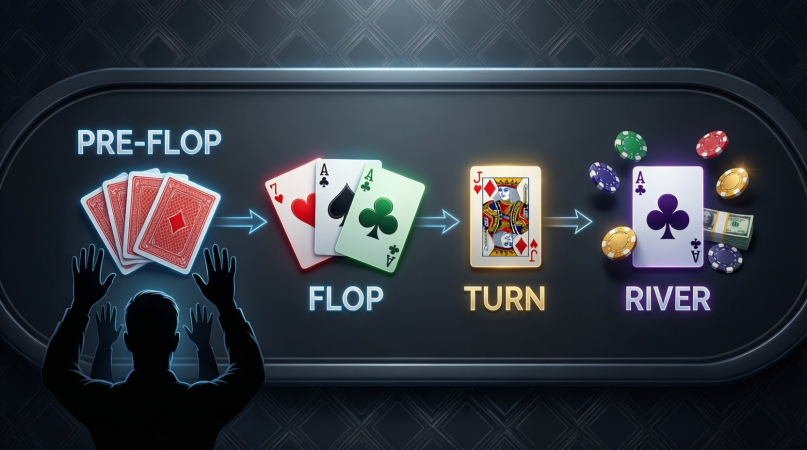
Pre-Flop
The pre-flop phase is the stage before any community cards are dealt. Players decide to fold, call, or raise based on their hole cards.
Flop
The flop is the first three community cards revealed. This is when players begin forming their hands.
Turn
The turn is the fourth community card. Strategies often change here as more information becomes available.
River
The river is the fifth and final community card. Players make final betting decisions at this stage.
4. Other Common Terms
- Bluff: Pretending you have a strong hand to force opponents to fold.
- Pot: The total money or chips in play during a hand.
- All-In: Betting all your remaining chips.
- Position: Your seat relative to the dealer, influencing your strategy.
- Dealer Button: Indicates the dealer position and who acts last in betting rounds.
- Small Blind & Big Blind: Forced bets to start the action and build the pot.
Benefits of Knowing Poker Terms
- Improved Gameplay: Understanding terms helps make better decisions.
- Strategic Advantage: Recognize when opponents are bluffing or strong.
- Faster Learning: New players grasp game mechanics quickly.
- Confidence: Reduced hesitation and indecision.
- Social Interaction: Easier to communicate in live or online games.
- Reduced Mistakes: Avoid costly errors by knowing when to act.
Disadvantages / Risks
- Overconfidence: Knowing terms doesn’t guarantee skill.
- Misinterpretation: Misunderstanding a term can lead to poor decisions.
- Intimidation: Overuse of jargon might confuse others in casual games.
- Overreliance: Focusing only on terms without practicing strategy can be harmful.
Common Mistakes to Avoid
- Skipping Learning the Terms: Jumping into games without knowing terms leads to confusion.
- Misreading Hand Strength: Ignoring the value of your cards compared to the board.
- Overbluffing: Bluffing too frequently can make you predictable.
- Ignoring Position: Betting without considering your place at the table.
- Not Managing Chips: Failing to understand terms related to betting amounts and strategy.
- Neglecting Opponents’ Behavior: Ignoring what others are doing can be costly.
May be you like it:
Bonus Terms Explained: A Complete Beginner’s Guide
Safe Gambling Checklist: How to Play Responsibly Every Time
Bankroll Management – Master Your Finances and Maximize Profits
FAQs
1. What is the most important poker term for beginners?
The most important term is fold, as knowing when to fold prevents unnecessary losses and is crucial for strategy.
2. What does “nuts” mean in poker?
“Nuts” refers to the best possible hand at any given moment. Example: If you have a royal flush, you hold the nuts.
3. How can I remember poker terms easily?
Practice regularly, use flashcards, and play small games while actively recalling terms like call, raise, and check.
4. Are poker terms the same in all variations?
Most terms like fold, bet, and bluff are consistent, but some, like specific hand rankings, may vary slightly in games like Omaha or Seven-Card Stud.
5. Why is position important in poker?
Position determines when you act in a round. Acting last gives more information about opponents’ moves and allows smarter decisions.
6. How does understanding terms improve my game?
Knowing terms lets you interpret gameplay faster, react strategically, and avoid mistakes. It also helps in reading opponents and planning bets.
7. Can I learn poker terms online?
Yes, online tutorials, videos, and practice games are excellent ways to memorize and apply poker vocabulary.
8. Is bluffing risky for beginners?
Yes, bluffing can be risky if done too often or without understanding opponents. Beginners should focus on hand strength before bluffing.
Expert Tips & Bonus Points
- Start Small: Focus on a few terms at a time instead of memorizing everything at once.
- Observe Others: Watch how experienced players use terms and apply them in context.
- Use Mnemonics: Create memory aids for hand rankings or betting terms.
- Practice in Low-Stakes Games: Apply terms in low-risk settings before playing for bigger stakes.
- Track Your Plays: Keep a journal of hands and actions, noting the terms you used.
- Learn Positioning: Position can be more valuable than hand strength; terms like “cutoff” and “button” matter.
- Combine Theory with Practice: Reading about terms is not enough—apply them actively.
Bonus: Understanding semi-bluffs and continuation bets will elevate your strategy beyond just knowing the basic terms.
Conclusion
Learning common poker terms is essential for anyone serious about improving at the game. These terms form the foundation for all poker strategies, from basic betting to advanced bluffing techniques. Without a solid grasp of poker vocabulary, even simple decisions can become confusing, leading to unnecessary mistakes.
By familiarizing yourself with terms like fold, call, raise, flop, turn, river, bluff, and many others, you gain a clearer understanding of gameplay, stronger strategic thinking, and increased confidence at the table. Remember, knowing the terms alone isn’t enough; practice, observation, and experience are critical for mastery.
Whether you are a beginner aiming to grasp the basics or an intermediate player refining your skills, understanding poker terms allows you to communicate effectively, make smarter decisions, and enjoy the game to its fullest. Start learning today, practice consistently, and watch your poker game improve with every hand.
[PRIMARY KEYWORD] is not just vocabulary—it’s the first step toward becoming a competent, confident poker player.
May be you like it:
Winning Micro Stakes: Beginner’s Guide to Success
3-Bet & 4-Bet Explained – A Simple and Practical Poker Guide
