


Introduction
Poker Basics for Beginners is the perfect starting point for anyone who wants to understand poker without confusion or stress. Poker is one of the most popular card games in the world, enjoyed in homes, clubs, and online platforms. While it may look complex at first, poker becomes easy and enjoyable once you learn the basics step by step. This guide is designed to help new and intermediate players feel comfortable at the table and make smarter decisions.
Many people think poker is only about luck. In reality, poker is a mix of skill, strategy, patience, and psychology. When you understand Poker Basics for Beginners, you begin to see patterns, read situations better, and manage your chips wisely. This knowledge helps you avoid common mistakes that often cost new players money and confidence.
In this article, you will learn what poker is, why it is important to learn correctly, and how to play using simple explanations. We will break down rules, hand rankings, betting rounds, and basic strategies in clear language. You will also discover benefits, risks, common mistakes, and expert tips that can improve your game over time.
Whether you want to play for fun with friends or aim to improve your skills for serious games, Poker Basics for Beginners will give you a strong foundation. By the end of this guide, you will understand how poker works and feel ready to sit at the table with confidence and control.
What is Poker Basics for Beginners?
Poker Basics for Beginners refers to the fundamental knowledge and skills needed to start playing poker correctly. Poker is a card game where players compete to win chips or money by forming the best hand or convincing others to fold. The game uses a standard deck of 52 cards and follows specific rules depending on the poker variant.
For beginners, poker basics include learning hand rankings, understanding betting actions, and knowing how each round works. It also involves learning table positions, basic poker terms, and simple strategies. These basics apply to popular poker games like Texas Hold’em, Omaha, and Five Card Draw.
Poker is not just about the cards you receive. It is also about how you play those cards. Knowing when to bet, check, call, raise, or fold is part of Poker Basics for Beginners. This knowledge helps players make logical decisions instead of emotional ones.
By focusing on the basics, beginners can enjoy poker without feeling overwhelmed. Once the foundation is clear, players can slowly move toward advanced strategies and deeper understanding.
May be you like it:
Common Poker Terms: A Complete Guide for Beginners
Top Providers to Know – Essential Guide for Beginners
Mobile Casino Tips for Beginners & Pros
Why is Poker Basics for Beginners Important?
Learning Poker Basics for Beginners is important because it saves time, money, and frustration. Many new players jump into games without understanding the rules or strategies. As a result, they lose quickly and feel discouraged.
Poker basics help you understand what is happening at the table. When you know hand rankings and betting rules, you avoid costly errors. This knowledge also helps you read situations and make better choices.
Another reason poker basics are important is confidence. When you understand the game, you feel more relaxed and focused. Confidence allows you to enjoy poker as a skill-based game rather than pure gambling.
Poker also teaches valuable life skills. Learning patience, discipline, and decision-making are key benefits. By mastering Poker Basics for Beginners, you build a strong base that supports long-term improvement and enjoyment.
Detailed Step-by-Step Guide
Step 1: Understand Poker Hand Rankings
Poker hand rankings are the heart of the game. Every player must know which hands are strong and which are weak.
Common poker hands include high card, one pair, two pair, three of a kind, straight, flush, full house, four of a kind, straight flush, and royal flush. The higher the ranking, the stronger the hand.
Learning these rankings helps you decide whether to bet or fold. Without this knowledge, poker decisions become guesswork.
Step 2: Learn Basic Poker Rules
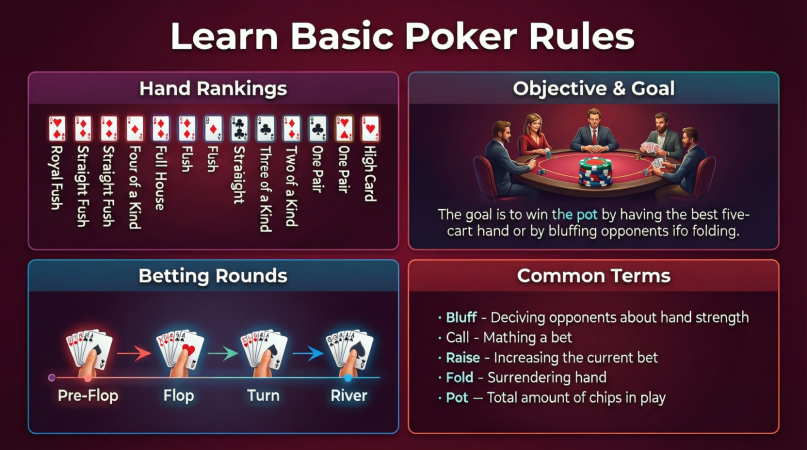
Each poker game follows a set of rules. In most games, players receive cards, place bets, and try to make the best hand.
Texas Hold’em is the most popular version. Players receive two private cards and share five community cards. The goal is to make the best five-card hand.
Understanding rules is a key part of Poker Basics for Beginners. Rules guide the flow of the game and ensure fairness.
Step 3: Know Betting Actions
Poker offers several betting options. You can check, bet, call, raise, or fold.
Checking means passing the action. Betting means placing chips. Calling matches a bet. Raising increases the bet. Folding means leaving the hand.
Knowing when to use each action is essential. Beginners should play cautiously and avoid risky bets.
Step 4: Understand Table Positions
Position refers to where you sit relative to the dealer. Early positions act first, while late positions act last.
Late position is an advantage because you see what others do before deciding. Poker Basics for Beginners includes learning to play stronger hands in early positions and wider hands in late positions.
Position awareness improves decision-making and reduces mistakes.
Step 5: Learn the Flow of a Hand
A poker hand moves through stages. These include the deal, betting rounds, and showdown.
In Texas Hold’em, betting rounds are pre-flop, flop, turn, and river. Each round gives players a chance to act.
Understanding the flow keeps you focused and helps you plan ahead.
Step 6: Practice Bankroll Management
Bankroll management means controlling how much money you play with. Beginners should never risk money they cannot afford to lose.
Set limits and stick to them. This habit protects you from emotional decisions and financial stress.
Poker Basics for Beginners emphasizes discipline and control.
Benefits of Poker Basics for Beginners
- Builds strong understanding of poker rules
- Improves decision-making skills
- Increases confidence at the table
- Reduces costly beginner mistakes
- Helps manage money responsibly
- Makes poker more enjoyable and less stressful
- Supports long-term skill development
Disadvantages / Risks
- Learning takes time and patience
- Beginners may still lose while gaining experience
- Emotional decisions can affect performance
- Overconfidence after small wins
- Risk of poor bankroll control
- Misunderstanding rules can cause confusion
Common Mistakes to Avoid
Many beginners play too many hands. This mistake leads to frequent losses. Instead, play strong hands and fold weak ones.
Another common error is ignoring position. Acting without considering position reduces your advantage.
Beginners also chase losses by betting emotionally. Poker Basics for Beginners teaches patience and discipline.
Failing to manage bankroll is another serious mistake. Always play within limits.
Lastly, many players focus only on cards and ignore opponents. Observing behavior and betting patterns is important.
May be you like it:
Bonus Terms Explained: A Complete Beginner’s Guide
Safe Gambling Checklist: How to Play Responsibly Every Time
Bankroll Management – Master Your Finances and Maximize Profits
FAQs
What is the best poker game for beginners?
Texas Hold’em is the best choice for beginners. It has simple rules and wide popularity.
How long does it take to learn poker basics?
Most players can learn Poker Basics for Beginners in a few days. Mastery takes longer with practice.
Is poker more skill or luck?
Poker is a mix of both. Skill matters more over the long term.
Should beginners play free games first?
Yes, free games help practice without financial risk.
How important is bankroll management?
Bankroll management is very important. It protects you from heavy losses.
Can beginners win at poker?
Yes, beginners can win by playing carefully and learning continuously.
Expert Tips & Bonus Points
Start slow and focus on learning rather than winning. Keep notes of mistakes and lessons.
Watch how experienced players act. Observation is a powerful learning tool.
Stay calm and avoid emotional play. Emotional control is part of Poker Basics for Beginners.
Review hands after sessions to understand decisions.
Always keep improving and stay patient.
Conclusion
Poker Basics for Beginners provides a clear and simple path for anyone who wants to start playing poker with confidence. Poker is not just a game of cards. It is a game of choices, patience, and understanding people. When beginners focus on the basics, they avoid frustration and build strong habits early.
This guide has explained what poker is, why learning the basics matters, and how to play step by step. You learned about hand rankings, rules, betting actions, positions, and bankroll management. You also discovered benefits, risks, common mistakes, and expert advice to guide your journey.
Poker rewards players who are disciplined and willing to learn. By applying Poker Basics for Beginners, you develop a solid foundation that supports long-term growth. You will make better decisions, manage your money wisely, and enjoy the game more.
Remember that every skilled poker player started as a beginner. Take your time, practice regularly, and stay focused on improvement. With patience and dedication, poker can become an exciting and rewarding experience built on knowledge, skill, and smart play.
May be you like it:
Winning Micro Stakes: Beginner’s Guide to Success
3-Bet & 4-Bet Explained – A Simple and Practical Poker Guide
